

Loading
Industries · Finance
In finance, the question is never just who logged in. It is who can see this account, approve this payment, or export this report, and whether you can prove it later. Permit answers that on every request, from a policy decision point running next to your services.

“It took us one day to implement Permit and one more day to deploy it onto staging and production”
 James WuCTO, Centauri AI
Relationship managers, analysts, approvers, auditors, and your clients’ own admins all need different slices of the same data. Static roles multiply until nobody can say what a role actually grants.
Whether an approval is allowed depends on the amount, the account, the region, and who initiated it. That logic ends up copied, slightly differently, into every service that moves money.
Your customers expect to define their own teams, share reports safely, and manage users without filing a ticket with your support team.
A login record does not explain why a specific user could open a specific statement last Tuesday. Reconstructing that from application logs takes days you do not have during an exam.
One policy layer for every service that touches customer money or data. Engineers review the policy as code, and your risk team can read it in the editor.
Default-deny policies combine roles with attributes like account ownership, amount, and region, and with relationships like which advisor covers which client.
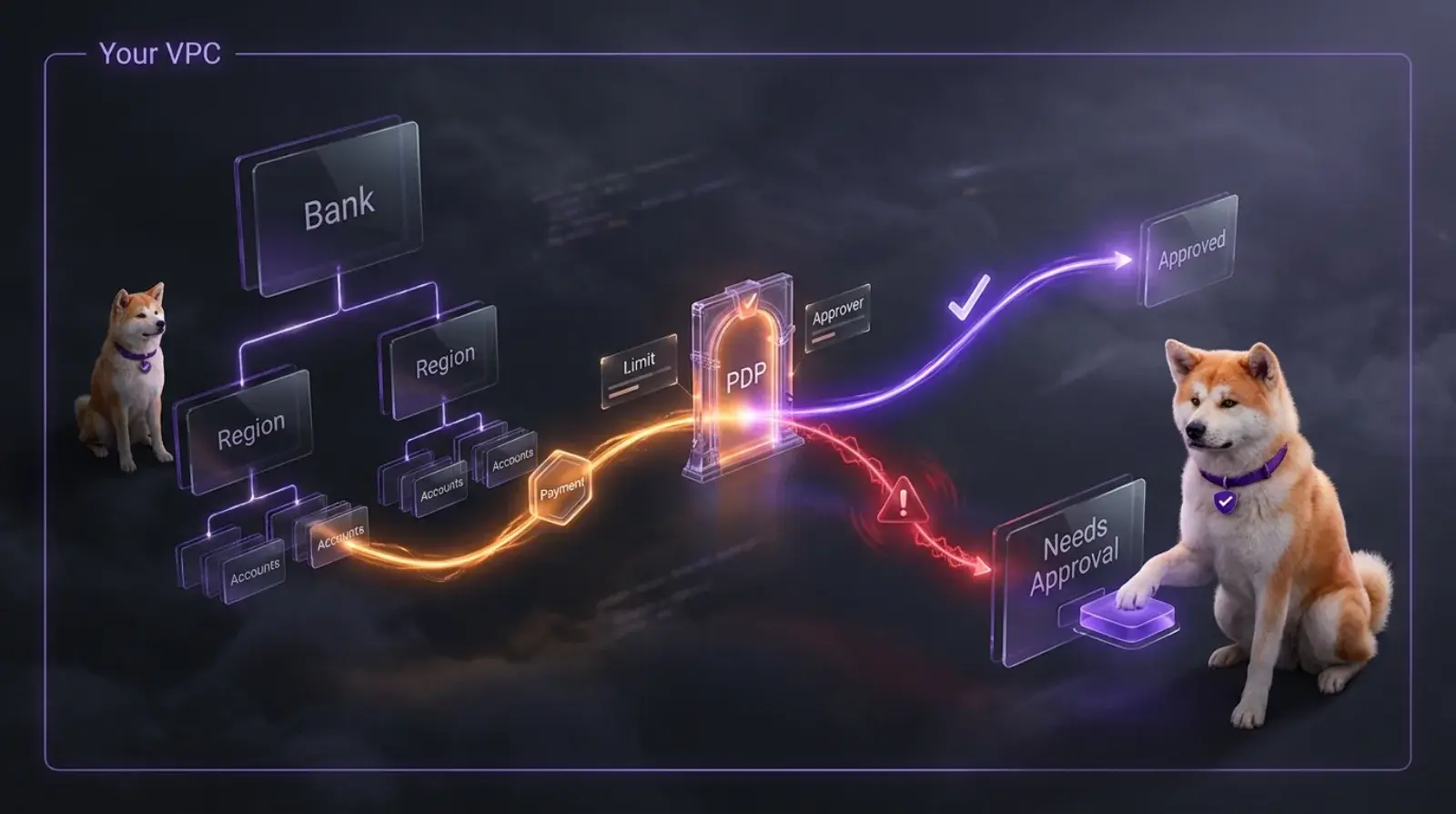
Write “whoever initiates a payment cannot approve it” once, and enforce it in every service that asks the decision point.
An API and embeddable components let enterprise clients manage their own users and roles, within the boundaries your policies allow.
Policy decision points run beside your services, so checks are answered inside your VPC, and they keep working from cached policy if the control plane is unreachable.
Each check is logged with the user, action, resource, outcome, and a plain-English reason, ready to forward to your SIEM.
Checked against separation of duties before the money moves. Illustrative data.
Hybrid deployment
Permit control plane
Permit cloud, or self-hosted
Your network
VPC, data center, or on-prem
Policy decision points
Run beside your services and gateways. Decisions keep working from cached policy.
Financial regulation keeps asking the same question in different words: is access limited to what each person needs, and can you show it. Here is where Permit fits.
| Framework | What it asks for | How Permit helps |
|---|---|---|
| SOX, Section 404 IT general controls | Logical access to financially significant systems is restricted, and changes to that access are controlled. | Policies live as code in your Git repository with review history, and every access decision is logged with its reason. |
| PCI DSS v4.0.1, Requirement 7 | Restrict access to system components and cardholder data by business need to know. | Default-deny policies scope access to the specific accounts, tenants, and data classes each role needs, enforced at every service. |
| GLBA Safeguards Rule | Implement access controls that limit authorized users to the customer information they need. | Attribute and relationship policies decide access per customer record, not per database or per application. |
| NYDFS 23 NYCRR 500.7 | Limit user access privileges, review them at least annually, and restrict privileged accounts. | Roles and policies are defined in one place for review, and approval flows add a recorded sign-off for elevated access. |
| DORA, Article 9 | Limit logical access to ICT assets to what is required for legitimate and approved functions. | One policy layer across services and AI agents, with decision logs that show each limit was enforced. |
Framework summaries are paraphrased for orientation and are not legal advice. No authorization vendor makes you compliant on its own. Permit helps you implement and evidence the access controls these frameworks test; your audits remain your own.
“Permit.io has been a game-changer for us. As an enterprise-focused organization, we recognized our need for advanced permissions and roles early on. Permit is one of the easiest integrations I've encountered, with exceptionally clear documentation. I constantly find myself recommending Permit.io to peers and colleagues - it’s great to have our authorization needs in their expert hands”
 Jowanza JosephCEO, Parakeet Financial
“If security slows down the application, developers will be tempted to skip security measures altogether—which is an even bigger risk. That’s why having a local PDP is extremely important for us.”
Yes. Policies compare attributes of the user and the resource, such as who initiated a transaction, so “the initiator cannot approve” is a single condition, enforced wherever the decision point is called.
No. In the hybrid model, policy decision points run inside your network and only opaque identifiers need to reach Permit’s control plane. Fully self-hosted deployment is also available.
Every decision is logged with the user, action, resource, the policy that applied, and a plain-English explanation. Logs can be forwarded to your SIEM and retained under your own policy.
Yes. Through the API or embeddable Elements components, clients create roles and assign users inside the boundaries your policies define.
Checks are answered by a policy decision point running next to your service, so they never cross the internet. In Centauri AI’s case study, checks with a local PDP ran in single-digit milliseconds.
Yes. Agents are checked against the same policies, acting on behalf of a person whose live permissions are the ceiling. The MCP Gateway adds consent and intent checks on every agent tool call.
Tell us what you are authorizing and where it runs. We come to the call with a model of how Permit would enforce it.