Modern applications, especially those built with cloud-native and microservice architectures, require precise, dynamic, and fine-grained authorization. Managing real-time access control across distributed systems is a complex challenge that requires handling frequent changes to both policies and data. To address this, OPAL (Open Policy Administration Layer) offers an open-source solution that keeps authorization layers synchronized with these changes in real-time.
OPAL integrates seamlessly with policy engines such as Open Policy Agent (OPA) and AWS Cedar, enabling you to create an authorization layer that adapts to your application's specific needs. By continuously keeping policies and data up-to-date, OPAL ensures that authorization decisions are always made based on the most current information.
In this article, we will explore the key challenges of modern authorization and how OPAL provides a structured, real-time solution for managing permissions across distributed environments.
Please consider giving OPAL a ⭐ on GitHub to support the project
Watch a demo of OPAL here:
The Challenges of Building Fine-Grained Authorization
As mentioned in the introduction, building an authorization layer that supports fine-grained policies (Such as RBAC, ABAC, and ReBAC) while considering data from sources external to your application (Think "A user can only access this part of the application if they paid for it with Stripe) is a complex task. In this section, we will go over some of these challenges and how OPAL can help you address them.
Handling Distributed, Microservice-Based Architectures
Managing authorization in distributed, cloud-native applications is inherently complex. With microservices, each component requires specific and often unique policies that must adapt in real-time to changes in user roles, data, and external conditions. This has driven the demand for fine-grained authorization, where permissions are tailored precisely to the needs of individual users and actions within an application.
Decoupling Policy and Code
Decoupling policy from application code is another important challenge to tackle.
Embedding authorization logic directly within code makes it hard to maintain and scale as policies change, while services risk becoming inconsistent as their authorization rules drift apart over time. Decoupling policies from code by managing them through a dedicated service is a best practice, but it requires the right tools for efficient implementation.
The Need for Policy Engine Support
While policy engines like Open Policy Agent (OPA), AWS Cedar, and OpenFGA provide strong decision-making capabilities that decouple the policy as code, integrating these engines into dynamic applications presents its own challenge: ensuring that policies and authorization data stay in sync with real-time changes. Applications often rely on external data sources, such as databases or third-party services, and any changes to this data—such as updates to user roles or permissions—must be reflected immediately in access control decisions. Without real-time synchronization, authorization layers can become outdated, creating security risks.
The Question of Scale
Finally, scalability is a key consideration. As the number of microservices grows, managing policies across services becomes increasingly difficult. Each service may require access to a different subset of policies and data, and manually keeping everything in sync is inefficient and prone to error. Not only that, the functional requirements of the authorization service could change and require multiple engines to incorporate together. For example, we might want to use OpenFGA as a store for graph-based permissions and OPA for conditional rules.
How Can OPAL Help
This problem is not an uncommon one. Organizations such as Netflix and Pinterest, which rely on OPA as their policy engine, were required to create their own solutions, building multiple administration layers on top of OPA. Manish Mehta, a senior security officer from Netflix, shared Netflix’s permissions design in a talk at KubeCon.
Unfortunately, these companies haven’t open-sourced their solutions, but their work did inspire the creation of OPAL.
OPAL addresses these challenges by providing real-time synchronization of policy and data across distributed systems, allowing fine-grained authorization to be implemented efficiently. It integrates seamlessly with engines like OPA and AWS Cedar, ensuring that policies remain decoupled from application code and that authorization decisions are always based on the latest data.
Key Features of OPAL
OPAL offers a comprehensive set of features that simplify authorization management, ensuring that policies and data are always up-to-date. Here’s how each feature helps address the challenges of fine-grained authorization:
Centralized Policy Configuration with Decentralized Engines
Managing policies centrally while allowing services to make local decisions is a significant challenge in distributed systems. OPAL centralizes policy configuration, making it easy to control and audit policies, while still allowing each policy engine to manage its own data and make local decisions. This ensures flexibility without sacrificing centralized control over access rules.
GitOps for Cloud-Native Deployments
Cloud-native applications often rely on GitOps for infrastructure management. OPAL integrates seamlessly with GitOps workflows by using Git’s native capabilities—such as branching, versioning, and pull/push mechanisms—to track changes in policies. This allows policy configurations to be treated like code, ensuring that they are synchronized across deployments.
Event-Driven Data Sync
OPAL ensures that policies are always in sync with the latest data by using an event-driven model. When data changes (e.g., updates in user roles, or external service statuses), OPAL pushes those updates in real-time to the policy engine, ensuring that authorization decisions are based on accurate and up-to-date information.
Support for Multiple Data Sources
Modern applications rely on diverse data sources, including databases, APIs, and external services. OPAL’s flexible data fetcher architecture allows it to pull in data from multiple sources and update the policy engine accordingly. This automates the process of keeping policies synchronized with the most relevant and up-to-date data.
Testing Across Multiple Versions and Data Sources
Testing policy configurations across different versions and data sources can be difficult, especially in environments that change frequently. OPAL simplifies testing by allowing multiple deployments across different policy versions and data sources, making it easier to test authorization policies in parallel with the application development lifecycle.
Simplified Deployment Model
Deploying policy engines often requires complex orchestration, but OPAL’s client-server architecture simplifies this. The OPAL server tracks changes to policy and data, while OPAL clients—deployed alongside each service—fetch updates and enforce policies locally. This architecture allows for decentralized policy enforcement, while keeping policy configuration and data management centralized.
CI/CD Integration
OPAL integrates seamlessly with CI/CD pipelines by automating policy updates. It ensures that policies are synchronized with software updates, reducing the need for manual intervention. With OPAL, developers can be confident that policies are always up-to-date, even as new versions of the application are deployed.
Multi-Engine Support
Many applications use more than one policy engine to handle different aspects of authorization. OPAL supports multiple policy engines, such as OPA, AWS Cedar, and OpenFGA, allowing them to be deployed and managed simultaneously. This ensures that all policy engines remain synchronized, enabling fine-grained authorization across multiple systems.
Full-Stack Permissions Management
OPAL simplifies managing permissions across all layers of your stack—from frontend to backend to databases—by enabling policy engines to be deployed across every layer. This ensures that permissions are consistently enforced across all components, preventing mismatches or security gaps between different parts of the application.
Hybrid Cloud Support
Managing authorization across hybrid cloud environments—such as a combination of on-premise and cloud infrastructure—requires coordination. OPAL provides built-in support for hybrid environments, ensuring that policies and data remain synchronized across both on-premise systems and cloud-based services.
Clean Code and Best Practices
Authorization code often becomes complex and hard to maintain as systems scale. OPAL promotes clean code practices by separating policy configuration, data synchronization, and enforcement. This division of responsibilities allows developers to manage policies in a way that adheres to best practices, ensuring maintainability and scalability.
Real-World Use Cases of OPAL
OPAL is a powerful tool that ensures the authorization layer of your applications stays in sync with real-time policy and data changes. It is used by companies such as Walmart, The NBA, Intel, Cisco, and Live-Oak Bank to manage complex, fine-grained authorization scenarios. Below are some of the key use cases where OPAL proves invaluable:
- End-to-End Fine-Grained Authorization Service: OPAL can be used with any policy language or data store to implement a full-stack fine-grained authorization system, ensuring precise access control across all layers of an application.
- Google-Zanzibar Support for Policy as Code Engines: OPAL supports policy engines like OPA and AWS Cedar, helping developers implement authorization following the Google Zanzibar model, which is designed for policy-as-code environments.
- Streamlining Permissions in Microservice Architectures: With OPAL, centralized policy configuration is possible, even when dealing with decentralized data sources and policy engines. This is particularly useful for microservice-based architectures where access control needs to be fine-tuned for each service.
- Automating Deployment of Multiple Policy Engines in Cloud-Native Environments: OPAL simplifies the process of deploying and managing multiple Open Policy Agent engines in cloud-native systems, ensuring that each instance stays synchronized with the latest policy and data changes.
These use cases demonstrate how OPAL addresses real-world authorization challenges by ensuring policies and data remain up-to-date and synchronized across distributed systems. Additionally, Permit.io has built its core authorization service on OPAL, relying on it to keep thousands of policy engines synchronized and to handle millions of authorization checks daily.
OPAL’s Architecture: A Technical Overview
OPAL’s architecture is designed for efficiency, scalability, and seamless integration with modern policy engines such as OPA, AWS Cedar, and OpenFGA. It operates on a client-server model, where the OPAL Server and OPAL Clients work together to keep policy engines synchronized with the latest policies and data in real-time.
This architecture ensures that policy decisions are always based on the most current information, regardless of where the data or policies originate. Additional information about OPAL's architecture is available in the OPAL Documentation.
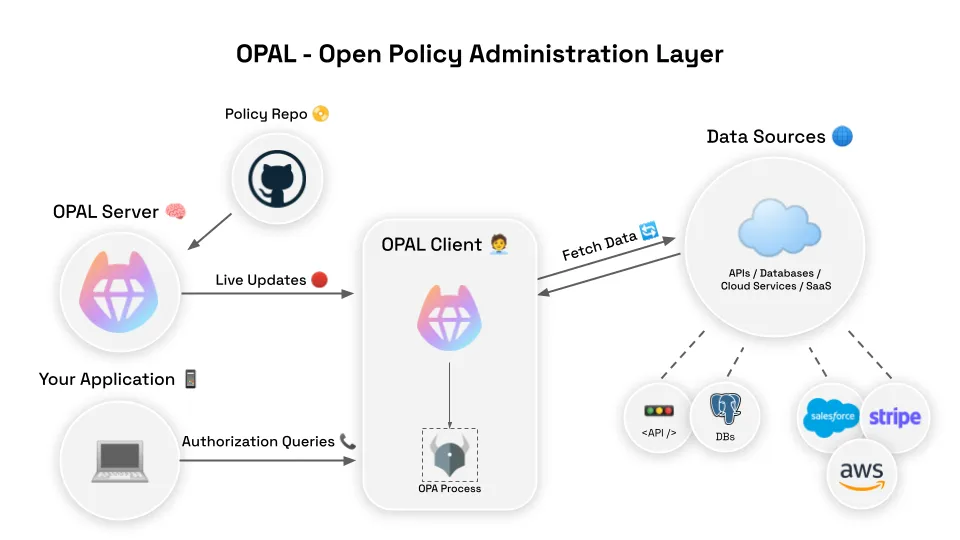
OPAL Server
The OPAL Server is responsible for tracking changes in policy repositories (such as GitHub, GitLab, or Bitbucket) and relevant data sources (e.g., APIs, databases, or external services). It continuously monitors these sources for updates, whether by webhook or by polling, and pushes these updates to the OPAL Clients via a WebSocket-based Pub/Sub mechanism.
The server plays a dual role:
- Policy Tracking: It acts as the Policy Administration Point (PAP), tracking changes to policies and ensuring that these changes are immediately propagated to the relevant policy engines.
- Data Tracking: The OPAL Server also monitors data sources, signaling the OPAL Clients when new data is available, ensuring that policy decisions are made based on the latest data.
OPAL Client
The OPAL Client is deployed alongside policy engines, such as OPA or AWS Cedar, to receive real-time updates from the OPAL Server. It subscribes to specific topics—such as policy changes or data updates—and fetches the relevant information directly from the source when notified.
The client has two main roles:
- Policy Propagation: When the OPAL Server detects a policy change, the client fetches the updated policy and loads it into the local policy engine (e.g., OPA), ensuring the latest policy is applied for all access control decisions.
- Data Fetching: For data-driven policies, the OPAL Client can pull updated data from external sources when the OPAL Server signals that a change has occurred. This data is processed and formatted for the policy engine, ensuring decisions are based on accurate, up-to-date information.
Data Fetchers
A key component of OPAL is its flexible data fetcher architecture. Each data fetcher is responsible for querying a specific data source (e.g., a database, an API, or a third-party service) and processing the retrieved data into a format that can be used by the policy engine. Data fetchers can be customized based on the data source’s structure and the policy engine’s requirements, making OPAL highly adaptable to various use cases.
WebSocket-Based Pub/Sub Channel
OPAL uses a lightweight WebSocket-based Pub/Sub mechanism for real-time communication between the OPAL Server and its clients. When a change is detected—whether it’s in the policy repository or in a data source—the OPAL Server publishes the update to a relevant topic. Clients subscribed to that topic receive the update in real time and can immediately fetch the latest policies or data, ensuring that the authorization engine stays in sync with the latest state.
This architecture allows OPAL to operate in highly dynamic environments where policy and data changes occur frequently. By separating the tracking of policies and data from the execution of policy decisions, OPAL ensures scalability, flexibility, and consistent performance, even in complex, distributed systems.
Policy Engine Integration
OPAL acts as an essential administration layer, ensuring that policy engines like Open Policy Agent (OPA) and AWS Cedar operate effectively in dynamic environments. While both engines excel at making fine-grained authorization decisions, OPAL provides the missing piece: real-time policy and data synchronization, even across complex, distributed systems.
Enhancing OPA with OPAL
OPA is a widely-used policy engine that separates policy logic from application code. However, OPA lacks native mechanisms for tracking and syncing real-time changes to both policy and external data sources.
OPAL fills this gap by automatically detecting policy changes in version control systems and pushing updates to OPA in real time. Additionally, OPAL integrates external data sources (e.g., databases, APIs) into OPA, ensuring authorization decisions are made based on the latest data without requiring manual updates.
Extending AWS Cedar with OPAL
AWS Cedar, the policy language behind Amazon Verified Permissions (AVP), is designed primarily for use within the AWS ecosystem. Deploying Cedar outside AWS or in hybrid environments typically requires additional management.
OPAL enables AWS Cedar to be used across different environments, whether on-premises or in multi-cloud setups, by synchronizing policy changes and data updates in real time. This makes Cedar as flexible as OPA, allowing developers to use it beyond AWS environments while maintaining real-time policy accuracy.
Getting Started with OPAL
OPAL makes it easy to integrate real-time policy and data synchronization into your authorization systems. Whether you're using OPA, AWS Cedar, or other policy engines, OPAL provides simple installation and configuration options, with Docker/Docker Compose being the preferred setup method.
Installation and Setup
OPAL is designed to be deployed quickly, with pre-built Docker images available for immediate use. Docker and Docker Compose are the most efficient ways to get OPAL up and running, offering a plug-and-play approach that minimizes manual configuration.
Using Docker/Docker Compose: The fastest way to try OPAL is by using Docker Compose. With a single command, you can deploy both the OPAL server and OPAL client. This command pulls the necessary Docker images and starts OPAL instantly:
curl -L <https://raw.githubusercontent.com/permitio/opal/master/docker/docker-compose-example.yml> \\
> docker-compose.yml && docker-compose up
This command downloads the Docker Compose configuration file, sets up the OPAL server and client, and starts the services automatically. Docker simplifies the management of OPAL, ensuring that updates and scaling are handled effortlessly.
For Kubernetes Environments: For more advanced setups, OPAL also provides a Helm chart, allowing you to deploy it within Kubernetes clusters. This is particularly useful in cloud-native environments where you need to manage multiple OPAL clients at scale.
Configuring OPAL
Once installed, OPAL’s configuration can be tailored to your system’s specific needs. From tracking policy repositories to syncing external data sources, OPAL offers flexibility and customization to fit into any existing infrastructure.
- Policy Repositories: OPAL allows you to track your Git-based policy repository (e.g., GitHub, GitLab, Bitbucket) for policy updates. The OPAL server watches for changes in the repository and immediately pushes updates to OPAL clients, ensuring that policy engines like OPA are always running the latest version of your policies.
- Data Fetchers: OPAL can be configured to fetch data from various external sources, such as APIs, databases, or third-party services. These data fetchers ensure that policy engines always have access to the most current data, enabling accurate and real-time authorization decisions.
Documentation and Guides
To assist with setup and customization, OPAL offers comprehensive documentation and guides, making it easy to get started and configure OPAL for your specific use case. Key resources include:
- Getting Started Guide: A step-by-step guide that walks you through installing OPAL using Docker, setting up repositories and data fetchers, and configuring OPAL for real-time policy and data synchronization.
- How-To Guides: These guides provide in-depth tutorials on advanced topics, such as triggering data updates, configuring custom fetchers, and extending OPAL to fit specialized authorization requirements.
OPAL is an open-source project that thrives on the contributions and involvement of developers. Whether you're using OPAL in your projects, have questions, or want to help improve the project, the OPAL community is the place to connect.
- Slack Community: Join the OPAL Slack community to chat with other developers, share your experiences, and get real-time support from the team and community members.
- GitHub Discussions and Issues: If you have ideas, feature requests, or have run into an issue, the OPAL GitHub repository is the place to contribute. You can open issues, join discussions, or offer suggestions to help make OPAL even better.
- Contribute to the Code: If you're excited about adding to OPAL’s functionality or improving something, we welcome your contributions. Whether it’s a bug fix, a new feature, or better documentation, every contribution helps.
Conclusion
OPAL has established itself as an essential tool for managing fine-grained authorization in modern, distributed systems. By addressing the key challenges of policy synchronization, real-time data updates, and scalability, OPAL ensures that policy engines like OPA and AWS Cedar can operate effectively in dynamic environments. Whether you’re dealing with a microservice-based architecture, managing multiple policy engines, or integrating external data sources, OPAL provides a robust solution for keeping your authorization layer up-to-date and secure.
With features like centralized policy management, event-driven data synchronization, and seamless integration with CI/CD pipelines, OPAL simplifies the complexities of modern authorization. It has already been adopted by leading organizations for its ability to manage authorization at scale, making sure policies are enforced consistently and in real time.
If you’re looking for a practical and powerful way to experience OPAL, you can try it via Permit.io, which is built on top of OPAL. Permit.io uses OPAL as its core engine for handling real-time, fine-grained authorization, offering a streamlined and user-friendly experience for developers. By using Permit.io, you can harness the power of OPAL with minimal setup, getting all the benefits of OPAL’s real-time policy and data synchronization with an intuitive interface.
Join the OPAL community, try it out through Permit.io, and see how it can transform the way you handle authorization in your systems.