Best Practices to Implement Role-Based Access Control (RBAC) for Developers
Explore the process of implementing Role-Based Access Control (RBAC) in applications with policy as code, enhancing security and scalability.

- Share:

Loading
2938 Members
 Join Permit's Slack
Role-Based Access Control (RBAC) is a basic mechanism in authorization, used to help us define how resources are accessed within an application. While it appears simple, getting its architecture and implementation just right is a complex process requiring meticulous planning and execution.
This article will delve into the nuances of RBAC, guiding you through the intricacies of implementing a strong and scalable RBAC authorization in your application.
RBAC is an authorization model used to determine access control based on predefined roles. Permissions are assigned to roles (Like “Admin or “User”), and roles are assigned to users by the administrator. This structure allows you to easily understand who has access to what.
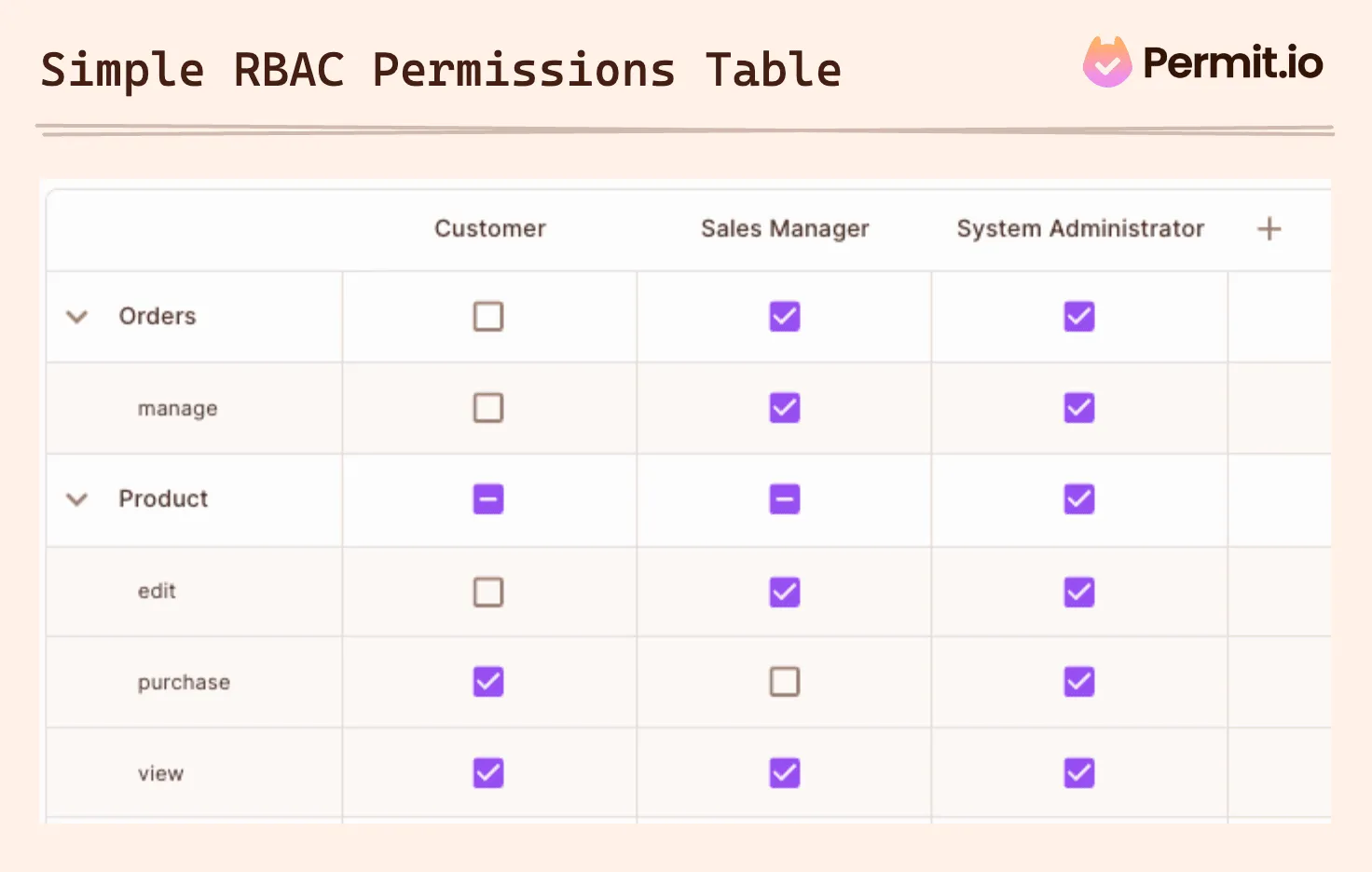
The combination of who (Which Identity, and what role are they assigned?) can do what (What actions are they allowed to perform) with a resource (On which aspects of the software) is called a policy.
Implementing Role-Based Access Control (RBAC) in your application is like laying the foundation of a building. It's about creating a structured, secure environment where every user has a clear, defined space to operate. This process is not just about restricting access; it's about enabling the right kind of access to the right people. Let’s lay down the basics of that:
By carefully following these stages, you can approach building an RBAC system that will not only protect your application but also enhance its usability and efficiency.
In the past, most of the application developers used to implement RBAC in one of these two approaches:
Using these approaches might seem like a good idea initially, yet they often lead to challenges that require a lot of developer time and, even worse, some major security issues:
ifs.The proper alternative to these approaches is to implement RBAC using Policy as Code in an External Authorization System. This method involves crafting policies as standalone code, independent of the application's core logic. This approach is particularly effective in dynamic, large-scale applications where roles and permissions are constantly changing.
Here's an Example of RBAC Policy in AWS Cedar Language 👇
permit(
    principal in Role::"admin",
    action in [
        Action::"task:update",
        Action::"task:retrieve",
        Action::"task:list"
    ],
    resource in ResourceType::"task"
);
Policy as code allows decoupling policy management from application code, enhancing flexibility and scalability. Using open-source solutions like Open Policy Agent (OPA), developers can write and manage policies in a high-level language like Rego. This separation allows for easier updates and maintenance of policies without impacting the application code.
The most important part of implementing authorization and RBAC is enforcing the permissions we have configured in the applications. There are three levels we can use to enforce the policy on users:
Choosing the right enforcement points and strategies in RBAC is about understanding your application's landscape and positioning your defenses where they will be most effective. It's a critical step in ensuring that your RBAC system not only secures your application but also supports its growth and evolution.
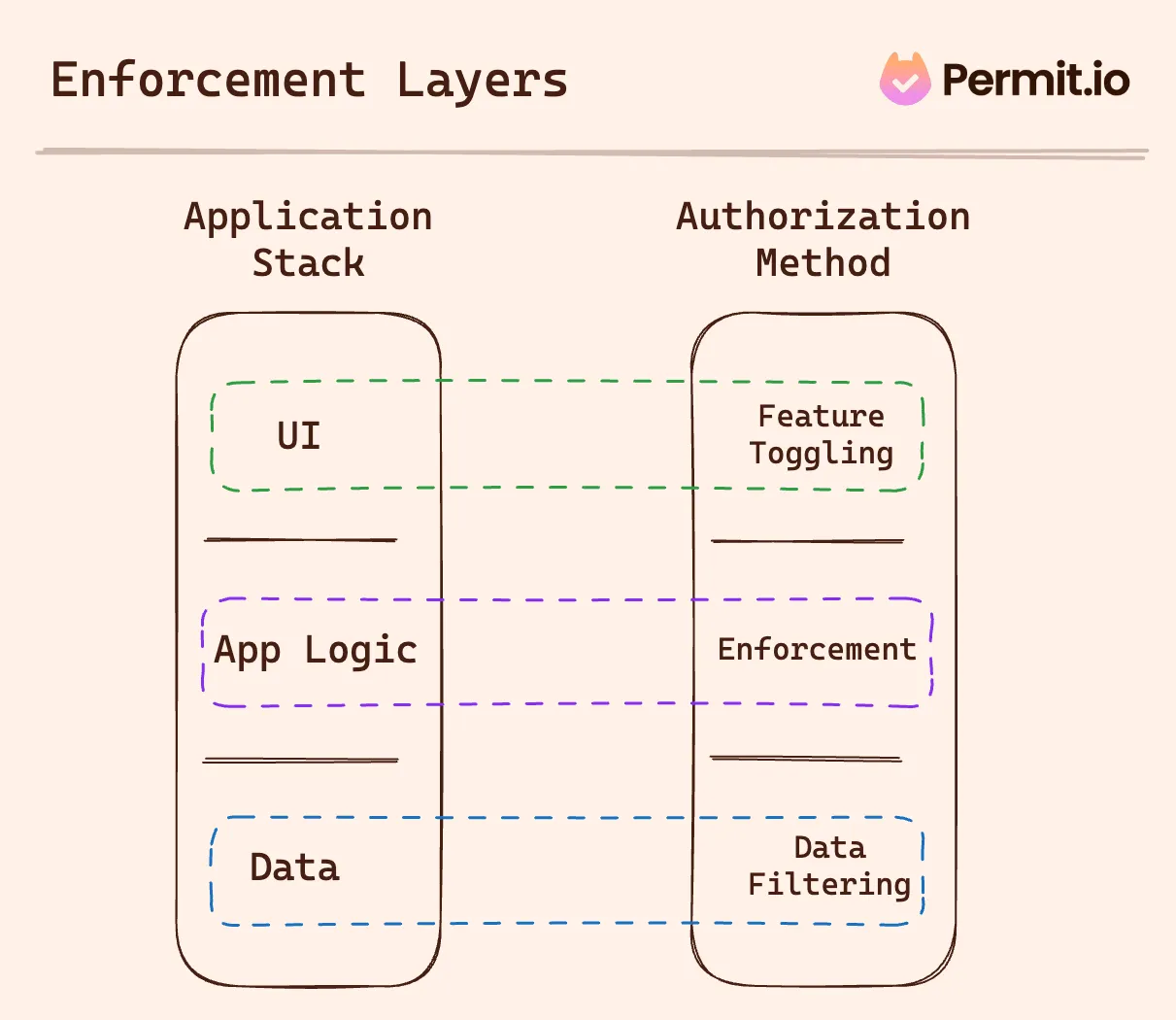
It is important to remember that in a well-designed policy-as-code authorization system, enforcement happens everywhere, while decision logic is always based on a single configuration.
When implementing RBAC in applications, there are two primary approaches for setting entities and assigning roles and permissions.
Discretionary Access Control (DAC) and Mandatory Access Control (MAC) offer contrasting approaches to access management, each with implications for Role-Based Access Control (RBAC).
In an RBAC system incorporating DAC, role permissions are flexible, allowing users to delegate or modify access within their discretion. Conversely, MAC within RBAC enforces strict adherence to predefined policies, ensuring consistent and secure access control.
In a traditional authorization system, DAC is considered weaker security-wise than MAC, as it is difficult to closely monitor its nature of constantly changing permissions. Policy-as-code based systems streamline the process of configuring policies so that no matter who makes configuration changes - the system audits them, maintaining a stable security posture.
Balancing DAC and MAC in RBAC depends on the organization's need for flexibility versus stringent security, aligning access control with business requirements and security policies.
Effective management and auditing are crucial in maintaining the integrity and effectiveness of an RBAC system. Managing RBAC involves regularly updating roles and permissions to adapt to changing user roles and business requirements. Through detailed logs, auditing tracks access and activities, ensuring accountability and identifying potential security breaches. This combination of management and auditing ensures that the RBAC system remains functional, secure, and aligned with organizational needs. To get the best out of your audit logs, make sure they follow authorization audit log best practices.
At some point, RBAC might not satisfy all the authorization needs of your application, requiring you to accommodate more complex authorization needs. This includes integrating more sophisticated permission models like Attribute-Based Access Control (ABAC) using policy as code. This approach allows for incremental and manageable expansion, accommodating new roles, resources, and changing business processes. It ensures the authorization system remains robust and adaptable, supporting the application’s growth and evolving requirements.
OPAL is an exemplary framework for scaling authorization in policy as code systems. By providing an administration layer with all the glue code needed, OPAL provides a policy-as-code end-to-end authorization system that lets you use policy as code for application authorization.
The following article provides a step-by-step guide to deploying an authorization system with OPAL.
RBAC is a powerful tool for managing application access, and policy as code is its most effective implementation method. Developers are encouraged to explore and adopt policy as code frameworks like OPAL for their RBAC needs. Contributing to the OPAL project on GitHub is a great way to support this evolving ecosystem. Want to learn more about Authorization? Join our Slack community, where thousands of developers are building and implementing authorization.

Full-Stack Software Technical Leader | Security, JavaScript, DevRel, OPA | Writer and Public Speaker