Best Practices for Authentication and Authorization in API
Explore best practices for authentication and authorization in API with clear, practical examples. Including a differentiation guide, and helpful code tips.

- Share:

Loading
2938 Members
 Join Permit's Slack
Strong access control is a major concern when it comes to API security - protecting against unauthorized data access and manipulation. This article delves into the various aspects of authentication and authorization in API development, specifically focusing on REST APIs.
Authentication and Authorization, though often mentioned in the same breath, serve distinct purposes in API security. Authentication validates the identity of users or systems attempting to access the API. This process establishes the 'who' in the interaction, ensuring that the entity making the request is indeed who they claim to be.
On the other hand, authorization comes into play post-authentication, determining the extent of access and actions permitted for the authenticated entity within the API. This step decides what an authenticated user or system can do, which resources they can access, and the operations they can perform.
REST APIs demand a fine-grained approach to authentication and authorization. As they are stateless, each request must contain all the information necessary for processing. Access control in this context must ensure seamless security without retaining user states, a challenge traditional session-based methods struggle to address.
The statelessness of REST architecture also influences the choice of authentication and authorization methods. Token-based authentication has become a frontrunner because it can carry sufficient user context in a stateless manner. Similarly, authorization techniques must be decoupled from the API logic to have a light footprint in the API code yet be powerful enough to handle complex access control requirements inherent in RESTful services.
Various personas emerge in API authentication, each with unique authentication needs. Let's go over them:
API calls go through various stages, each with its own security implications. Let's map out these stages:
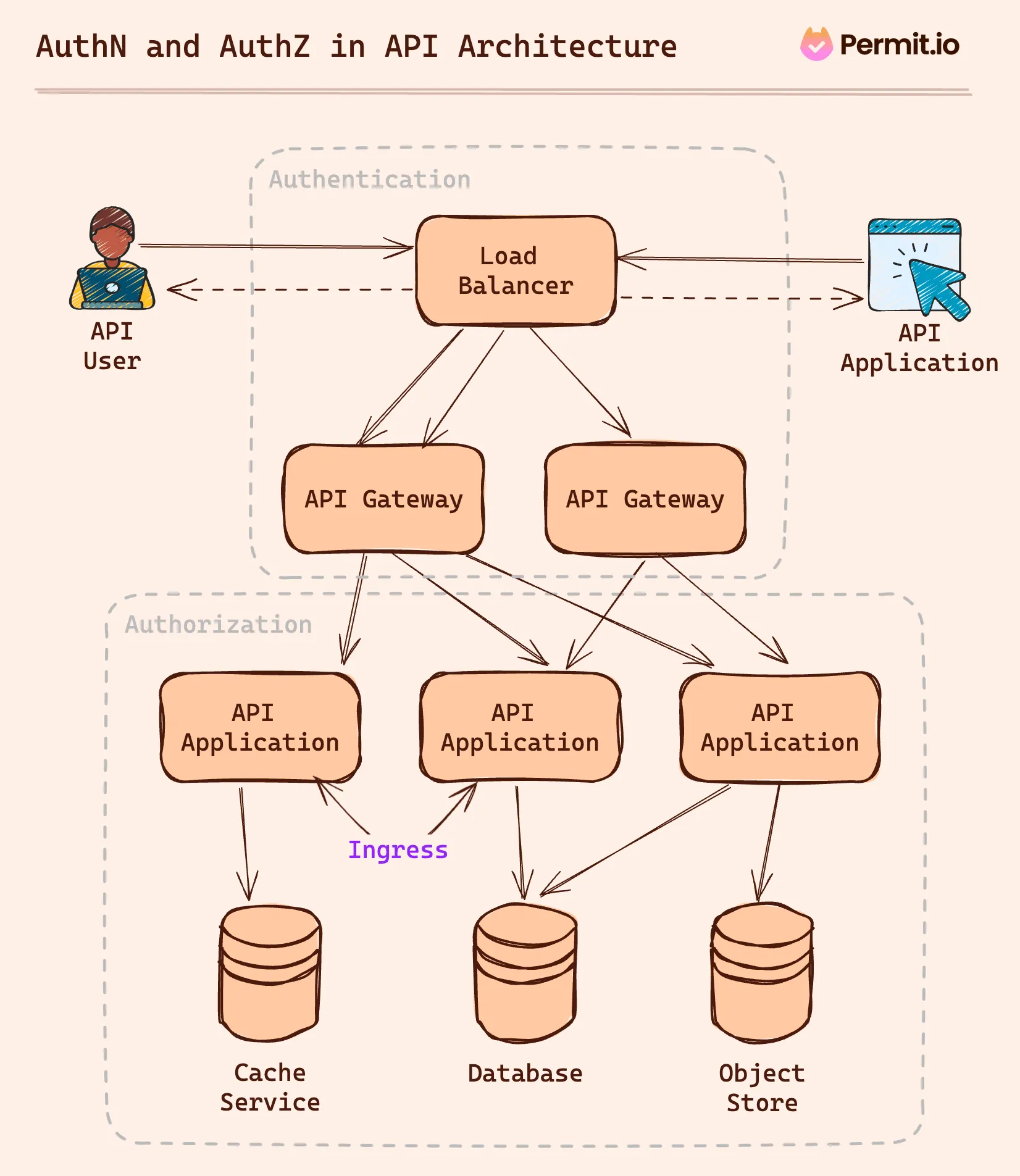
In the load balancer and API gateway stages, authentication predominantly involves verifying the requester's identity, often through API keys or tokens. The focus here is to ascertain if the caller is who they claim to be. Basic authorization can happen at this point using policy engines connected to the API gateway.
Once in the application code, the scope shifts more toward authorization. It's about validating permissions: can this user or service perform the requested action? This is where roles and policies come into play, delineating the boundaries of what each authenticated entity is allowed to do.
Finally, at the data layer, data filtering and partial evaluation authorization checks ensure data security and integrity, restricting data access to only those entities with appropriate rights.
Session-based authentication methods are becoming relics of the past in the world of APIs. Their reliance on server-side state management just doesn’t fit with the stateless nature of REST APIs. Each API call in a session-based approach requires server-side context, a difficult requirement to handle in scalable, distributed environments.
Token-based authentication, on the other hand, especially JSON Web Tokens (JWT), has become the gold standard in API authentication. JWTs encapsulate user identity and claims in a compact, self-contained format, making them ideal for stateless RESTful environments.
Think of an end-user accessing a web application. The application might use an OAuth 2.0 flow, where an external identity provider authenticates the user, and a token is issued. This token is then used for subsequent API calls, neatly encapsulating the user's identity and permissions.
For service-to-service (application-to-application) interactions, JWT tokens are exchanged, where each service authenticates the other using tokens signed with secure keys. This method ensures that each service is verifiable and trusted within the architecture.
Policy as Code represents a significant shift in managing and enforcing authorization rules. It involves defining security and operational policies in code, making them more dynamic, scalable, and maintainable. This approach aligns perfectly with modern infrastructure-as-code practices.
In the context of APIs, Policy as Code allows for flexible, context-aware authorization that can adapt to complex and changing requirements. It supports a decentralized approach, where policies are defined alongside the resources they protect, enhancing visibility and control.
OPAL (Open Policy Administration Layer) is an open-source project that facilitates policy-based authorization in APIs. It provides a real-time policy engine that integrates seamlessly with API infrastructures, allowing developers to easily enforce granular, context-driven policies. Here’s an example of using OPAL in a FastAPI application to enforce fine-grained authorization.
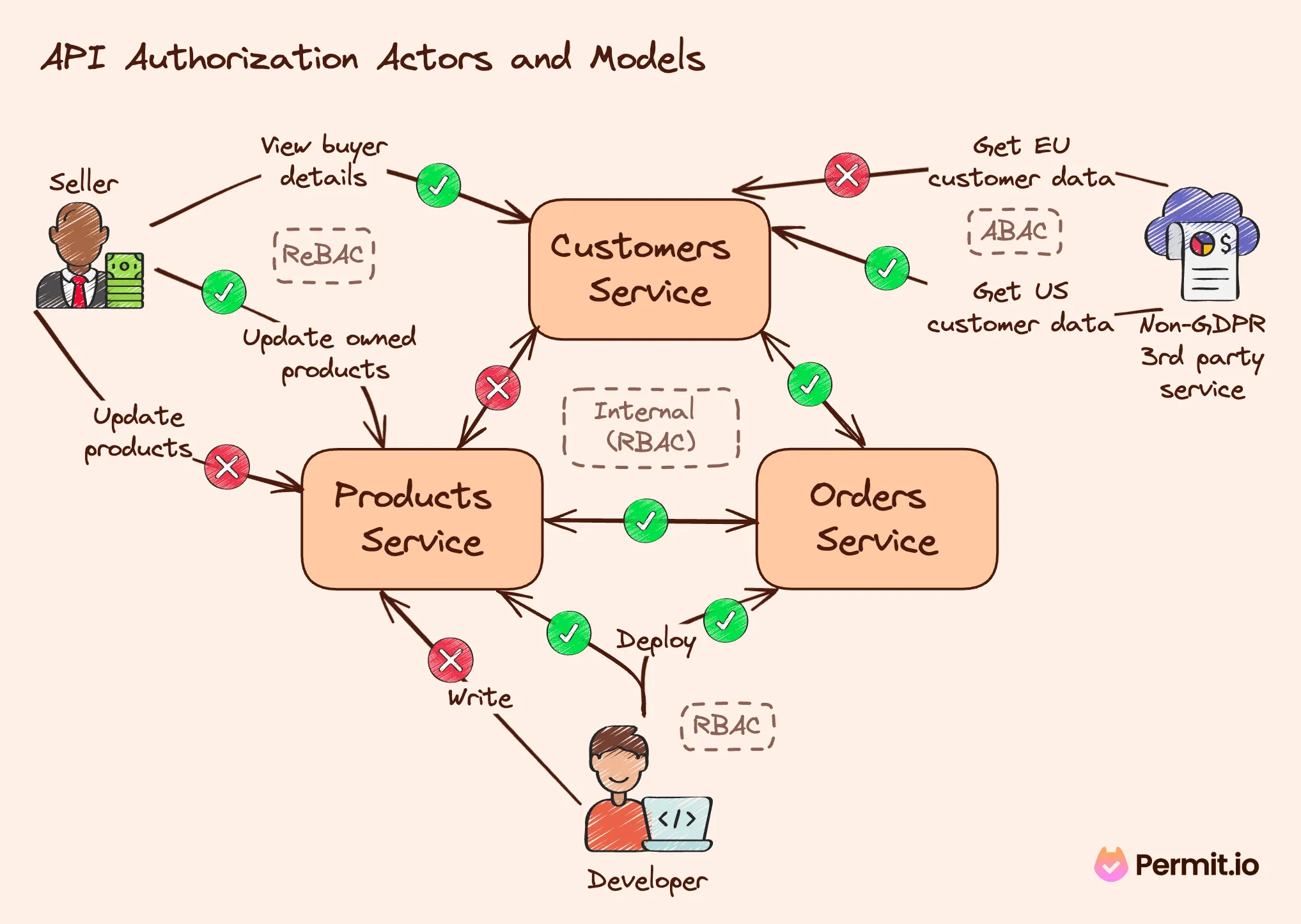
The following diagram illustrates how common permission models are incorporated in API applications. You can learn more about designing and implementing better authorization in APIs here.
Thorough testing is critical in the authentication and authorization landscape of APIs. This ensures that security mechanisms work as intended and can withstand various attack vectors.
Maintaining different testing environments, such as staging and production, allows for thorough testing without compromising real-world data or operations. Automated testing frameworks can simulate various authentication and authorization scenarios, providing comprehensive coverage.
Token-based authentication and Policy as Code methodologies are well suited to automated testing, with tokens being programmatically generated to test different authentication scenarios. Similarly, Policy as Code allows for automated testing of various authorization policies, ensuring they enforce the intended access controls.
Analyzing gaps in current practices is essential for continual improvement. Tools and practices should be periodically reviewed and aligned with emerging best practices and threats.
We encourage you to take part and contribute to open-source projects like OPAL, and leverage their capabilities in their API security strategies. Want to support the project? Star OPAL on GitHub, explore its functionalities, and integrate it into your API security framework.

Full-Stack Software Technical Leader | Security, JavaScript, DevRel, OPA | Writer and Public Speaker