Agent identity is becoming the enterprise control point
Enterprise security teams are now managing autonomous software actors that do more than call APIs: they interpret goals, choose tools, and execute multi-step workflows. That shift turns identity from a login concern into an execution-governance concern. The Open Source For You analysis of decentralized identity for AI agents emphasizes short-lived credentials, revocation, and guardian-style checks, which is the right direction for trust foundations. ServiceNow's AI Control Tower community quickstart article discusses AI asset inventory and discovery. Sumsub's MCP integration announcement highlights verification platform capabilities for compliance setups, with separate permissions and human approval for sensitive actions.
Taken together, these sources point to one architectural conclusion: agent identity is necessary for authentication, and runtime authorization is crucial for execution control. In enterprise settings, the decisive control is runtime authorization per action, not merely identification at session start.
Agent identity is not the same thing as machine identity
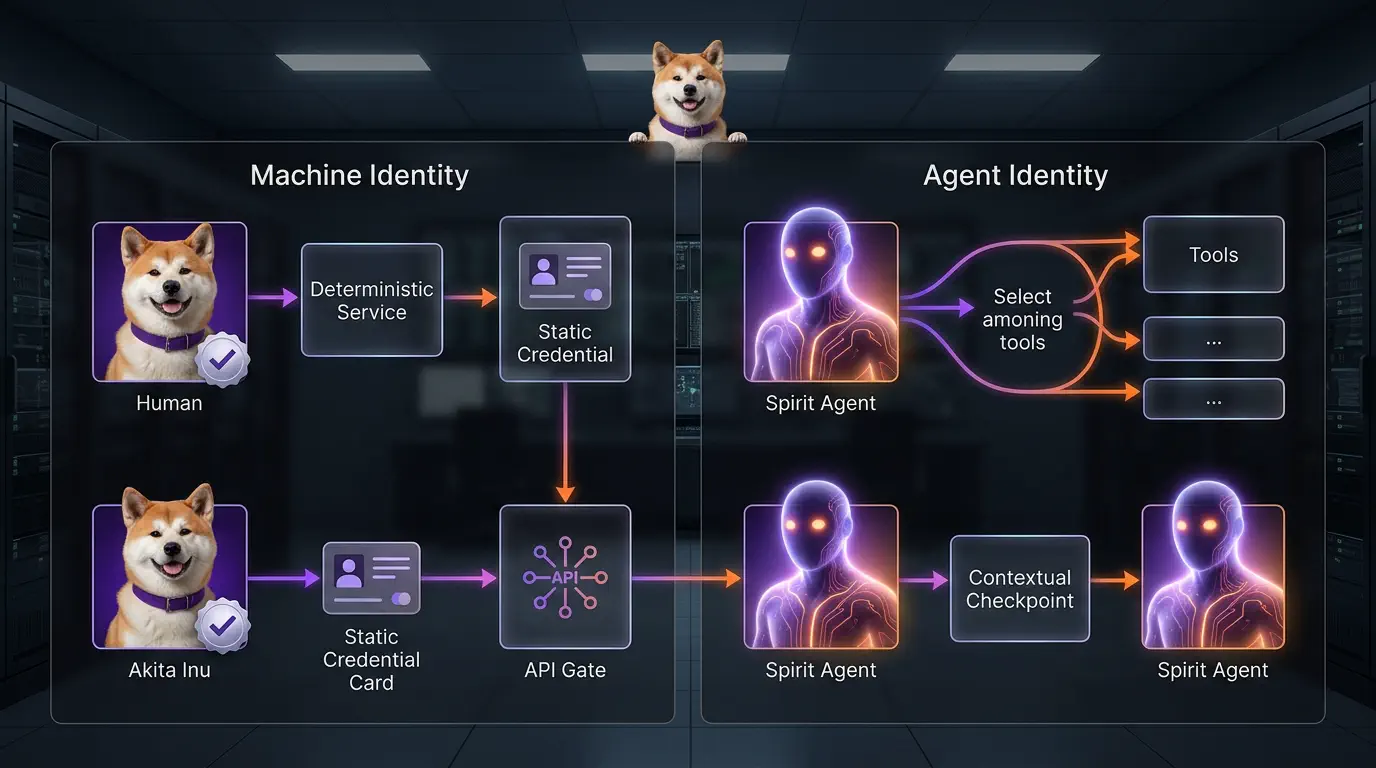
Traditional non-human identity models assume stable workloads with predictable behavior. That is why many teams still frame this as machine identity vs agent identity, but the two are materially different. A service account typically represents a system boundary and has static privilege expectations; agent identity represents an adaptive actor whose next tool call depends on context, plan evolution, and delegated intent.
This is where the language matters. Agent identity and agentic identity are forms of non-human identity, but they carry dynamic decision semantics. A machine can authenticate; an agent can authenticate and then decide, chain, and mutate behavior. That difference is exactly why per-action checks must accompany identity proof.
| Dimension |
Machine identity |
Agent identity |
| Behavioral model |
Deterministic or narrowly scoped |
Contextual, multi-step, tool-selecting |
| Privilege pattern |
Often long-lived and pre-provisioned |
Should be short-lived and task-scoped |
| Risk mode |
Credential theft and static over-permission |
Intent drift, wrong-tool execution, over-scope actions |
| Control focus |
Authentication + coarse RBAC |
Authentication + continuous runtime authorization |
DID for AI agents and verifiable credentials are foundations, not final control
A strong decentralized identity approach for AI agents provides each agent with a cryptographic root of trust for provenance and authentication, but it does not inherently include runtime authorization controls. The Open Source For You piece explicitly describes DID for AI agents as a "passport" model and calls out short-lived task credentials and revocation/guardian behavior, alongside policy checks before tool execution, which makes it strong identity hygiene and auditability groundwork for agentic systems.
Yet even excellent DID + verifiable credentials design does not by itself answer: "May this specific action happen now, in this tenant, for this intent, under this risk posture?" Credentials prove who and what was issued. They do not automatically enforce least privilege against live context shifts, especially when the agent's plan branches mid-run. In practice, DID and verifiable credentials reduce impersonation risk and improve provenance by providing strong identity verification, which complements action-time policy evaluation.
AI Control Tower visibility and MCP server inventory are not action-time enforcement
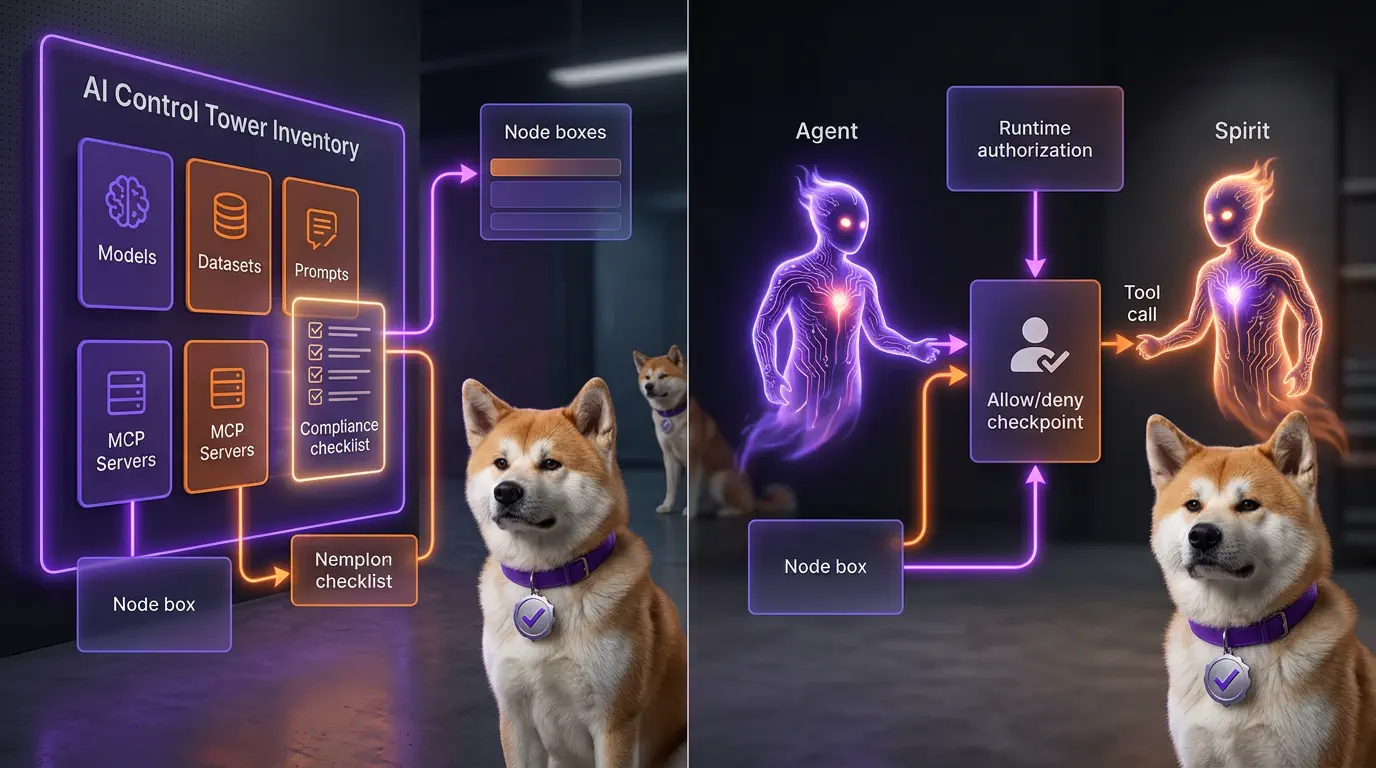
Enterprises need inventory because unmanaged assets are ungovernable. ServiceNow's AI Control Tower quickstart documentation is explicit that implementation includes AI asset inventory and discovery across AI systems, models, datasets, prompts, and MCP servers, with lifecycle and compliance alignment processes. That gives governance memory: what exists, who owns it, where it fits in lifecycle.
But MCP server inventory provides asset visibility, while runtime authorization determines if an agent may execute actions like a high-impact write against a specific record. Inventory answers "what is in the environment." Runtime authorization answers "what is allowed right now." Mature enterprise designs treat these as complementary planes: control tower for visibility and governance operations, enforcement plane for real-time gate decisions.
Delegated access must bind human authority, intent, and trust tier
Most real enterprise agent actions are delegated, not autonomous in a legal or accountability sense. The core control object should therefore bind the agent to a human delegator, a specific intent, and a trust classification. Without that binding, delegated access becomes disguised standing access.
An effective policy envelope for consent-based delegation should include these essential fields: human principal, agent principal, declared intent, trust tier, tool/action, resource/tenant, context, consent artifact, and policy version. This converts a generic credential check into an accountability check. It also enables zero standing permissions by issuing temporary authority only when a valid delegation context exists.
Failure cases become much easier to reason about under this model. A wrong tool call can be denied because it is outside delegated intent. Intent drift can be caught when later actions no longer match the original consent scope. Over-scope actions and cross-tenant access can be blocked by resource/tenant mismatch rules. High-risk actions can require step-up approval tied to the same delegation chain.
Runtime revocation and constraining must be continuous and responsive
Revocation that is not implemented in real-time is too slow for agentic execution loops. The Open Source For You discussion of automated revocation and guardian checks matters because it frames revocation as a live response to behavioral deviation, not an after-the-fact cleanup step. Sumsub's MCP compliance setup model with isolated flows and sensitive-action approvals shows similar operational guardrails.
Runtime constraining should be treated as a closed loop: detect context, decide policy, enforce, observe, and potentially revoke. If the agent crosses risk thresholds, issued permissions should contract immediately. If step-up approval is denied or expires, pending writes should fail closed. If trust signals degrade, permissions should downgrade from write to read or from broad tool scopes to a minimal subset.
Practical architecture: PEP/PDP with MCP gateway interception
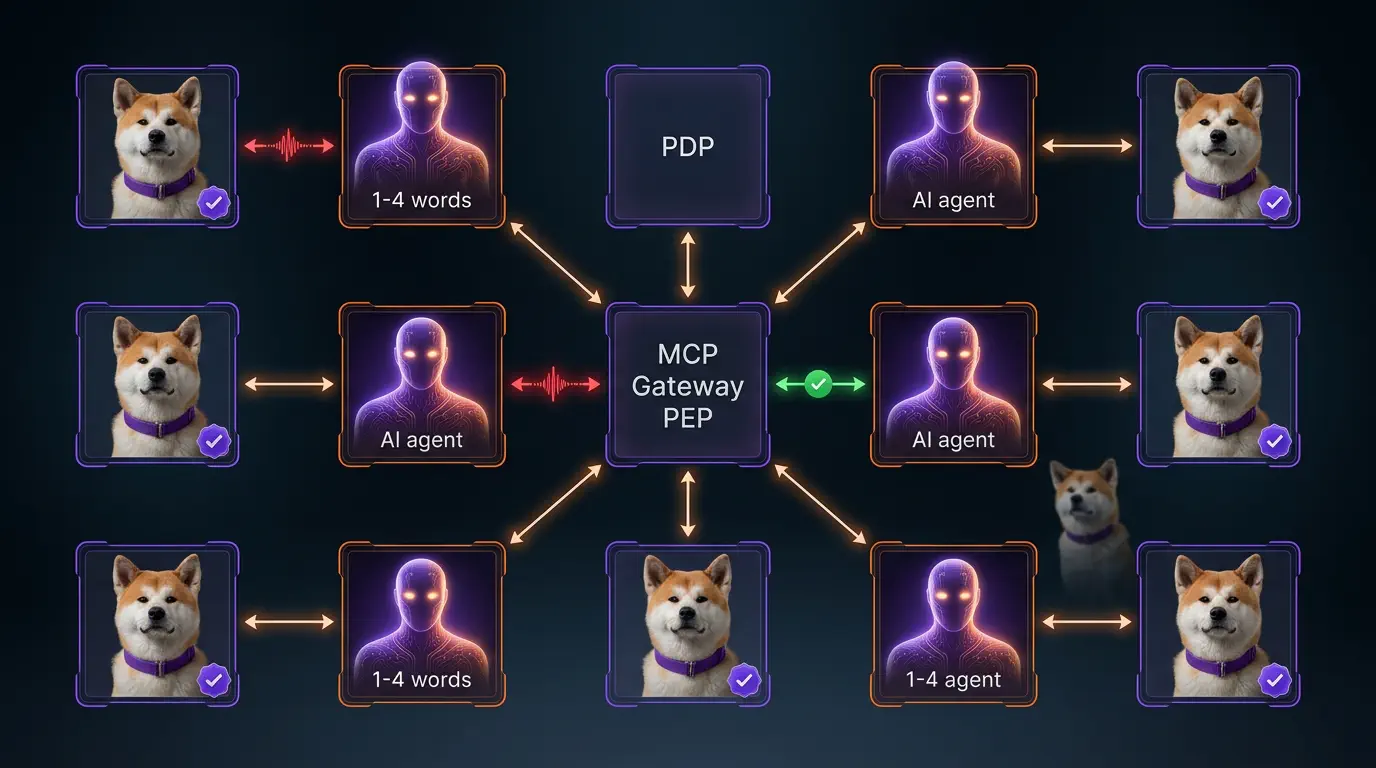
A workable enterprise pattern places a Policy Enforcement Point (PEP) at the MCP gateway and a Policy Decision Point (PDP) behind it. Every tool call is intercepted before execution, enriched with identity and context, evaluated against policy, and either denied or released with narrowly scoped, short-lived grants.
The policy decisioning envelope should carry: human, agent, intent, trust, tool/action, resource/tenant, context, consent, and policy version. That envelope is what makes runtime authorization explainable and auditable across retries, handoffs, and incident response.
After teams establish identity, inventory, delegation semantics, and runtime gates, an enforcement layer can operationalize policy distribution and decision APIs. In that implementation slot, platforms such as Permit.io can serve as policy orchestration infrastructure, but only as part of a broader architecture where identity issuance, MCP interception, and human-approval workflows are already defined.
Frequently asked questions
Is agent identity just a new label for service accounts?
Agent identity is related to service accounts but not equivalent. Service accounts represent static software principals, while agent identity covers adaptive actors that choose tools and sequence actions. That behavioral difference changes the authorization model from mostly pre-provisioned access to continuous per-action decisions.
Are DIDs and verifiable credentials still worth adopting if they are not sufficient?
DIDs and verifiable credentials are absolutely worth adopting because they improve provenance, interoperability, and cryptographic trust for non-human identity. They make issuer, subject, and credential lifecycle more explicit than ad hoc keys. The limitation is not their value; the limitation is expecting them to solve runtime policy decisions by themselves.
How does AI Control Tower help if it does not enforce every action?
AI Control Tower contributes governance structure: discovery, ownership, lifecycle, and compliance alignment for AI assets including MCP servers. That improves visibility, accountability, and program maturity. It should be paired with an action-time enforcement plane rather than treated as a substitute for it.
What does consent-based delegation look like in daily operations?
Consent-based delegation means an agent acts only within a bounded human-approved intent and scope. The approval must be machine-verifiable and time-bound, not a one-time blanket permission. In practice, this often means temporary grants tied to specific workflows, resources, and risk levels.
What is the operational meaning of zero standing permissions for agents?
Zero standing permissions means agents hold no durable broad privileges between tasks. Access is minted just in time, scoped to a concrete action set, and expires quickly. This dramatically reduces blast radius when an agent behaves unexpectedly or when credentials are exposed.
How should teams handle high-risk actions such as financial writes or policy changes?
High-risk actions should trigger step-up controls, usually human approval plus stricter policy checks and richer audit logging. The approval should bind to the exact action and resource rather than authorizing a whole session. If context changes after approval, the action should be re-evaluated and may be blocked.
What are the first runtime failure scenarios to design for?
Teams should prioritize wrong-tool selection, intent drift across long chains, over-scope operations, and cross-tenant access attempts. Each scenario needs explicit deny conditions and clear audit trails. Designing these controls early prevents "identity passed, damage still happened" incidents.
Where should revocation logic live in an agentic architecture?
Revocation logic should live in the runtime enforcement path, not only in an identity admin console. A gateway PEP and central PDP can terminate or downgrade permissions as soon as trust signals change. This is how revocable permissions become practical controls rather than governance documentation.